A few days ago I spent an afternoon with a man named Matt Yount, who grows microgreens here in the South Bay under the name Snack and Score.
I walked in thinking I knew a fair amount about nutrition. I walked out having learned more about how simple good nutrition can be, and why it keeps coming up in the coaching conversations we have every week.
What are microgreens, and are they really more nutritious?
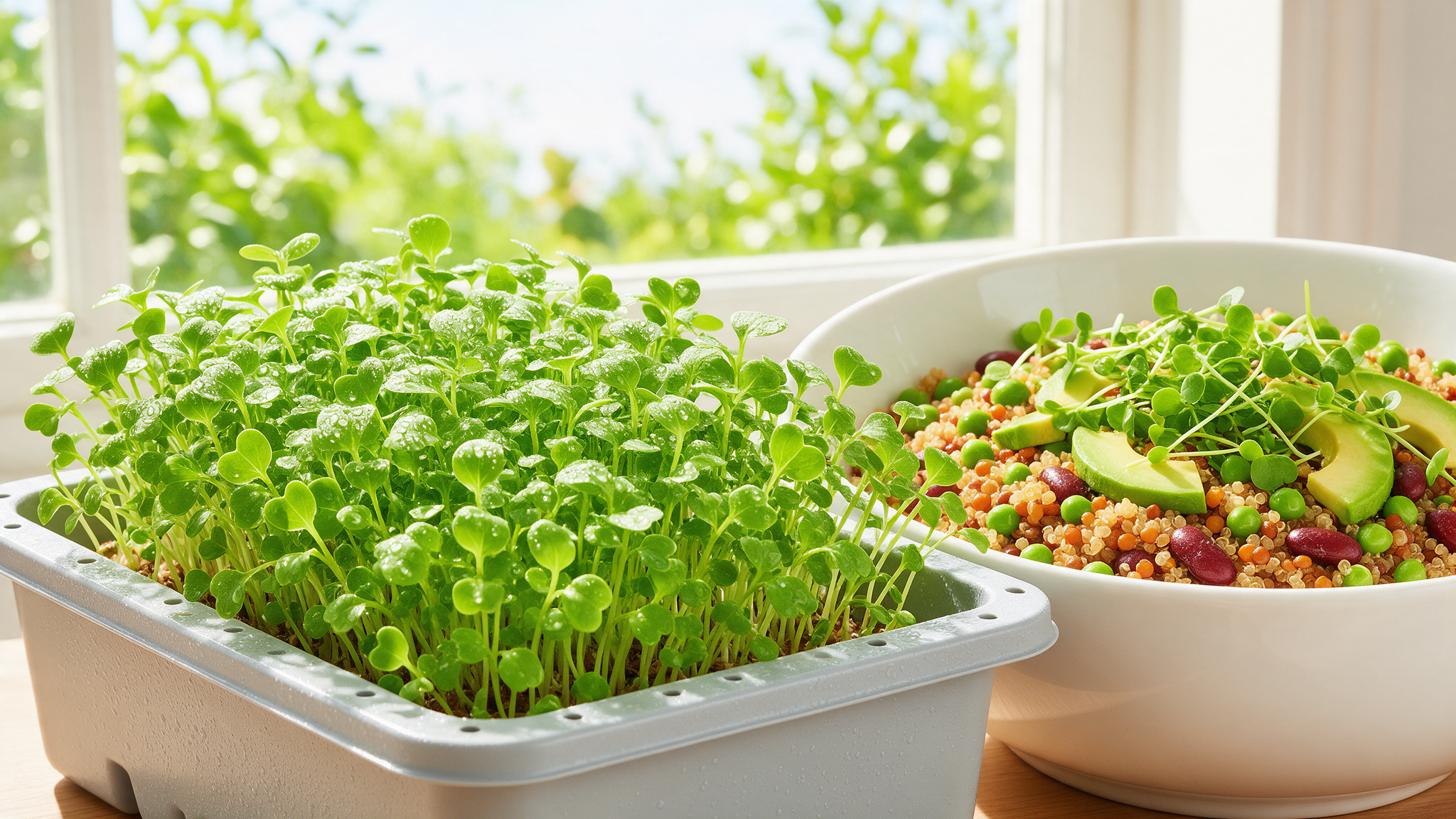
Microgreens are ordinary vegetables harvested when they are only a week or two old. Researchers at the University of Maryland and the USDA compared them to their full-grown versions and found that gram for gram many carry several times the vitamins and nutrients, in some cases up to forty times as much.
If you have never met one: broccoli, radish, sunflower, kale, cut right after the first little leaves appear. Small in size, but big in flavor.
I will wear that forty-times figure lightly, as always. It varies a great deal from plant to plant, and a handful of microgreens does not replace a plate of vegetables.
But the honest headline holds. A very small volume of food can carry a surprising amount of nourishment.
Why do microgreens help if I am on a GLP-1 medication?
Because they solve a volume problem. On a GLP-1, the changes in appetite are wonderful for fullness and satiety, but they can make it genuinely hard to eat a large quantity of vegetables in a day. Microgreens turn that on its head, folding a lot of nutrition into a very small bite.
So many of us, myself included, know we should eat more vegetables and simply struggle to get there. That struggle is not a character flaw. It is often just arithmetic.
When your stomach empties more slowly and you are full after a third of what you used to eat, every bite has to work harder. Density starts to matter more than volume.
How do I actually work them into what I already eat?
You do not cook them or make a project of them. Add a small handful to something you were already going to eat: an omelet, a bowl of pasta, a sandwich, a smoothie. The meal stays the same and the nutrition quietly goes up. That is the entire technique.
This is also the part of our work I love most. For a long stretch, so much of what we do has centered on weight.
True wellness was always the point: not only a number on a scale, but making it easier to put real, good nutrition into everyday life.
And I want to be clear about how I see this. I am not standing at the front of the room claiming to have it all figured out. I am on this road right alongside you, working on my own fiber and my own greens, one ordinary meal at a time.
So my small invitation: pick one meal this week and add a little something green to it that you normally would not. Notice how it feels to make the healthy choice the easy one.